


 Dedicated Server
 VPS Hosting
 Email Hosting
 Web Hosting


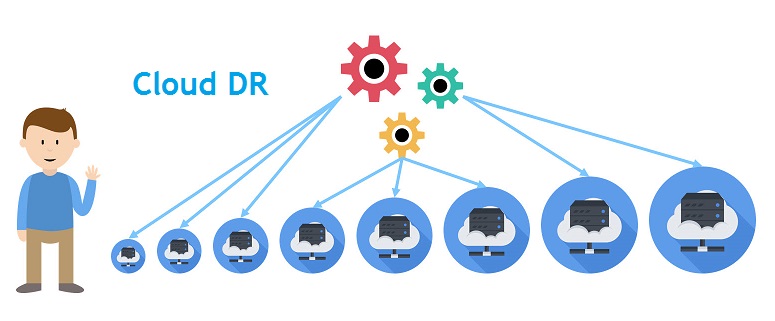
The importance of a foolproof DR strategy cannot be over-emphasized. It is better to be safe than sorry, especially when it is about your business applications. These are the life-force of your business and it is imperative to keep a check on the very latest DR practices in the world of today to safeguard oneself in turbulent times.
As is happening with all other practices, Cloud DR is emerging as a sure hope on the horizon for many CIOs that are grappling with the issue of acute shortage of IT resources. Cloud DR appears quite a feasible alternative to the traditional way since it does away with the requirement to have data center resources and related infrastructure.
But when have things ever been easy? There are challenges galore along this path too, especially since so far there has not been a common, single template that leads the way toward quick, hassle-free DR migration to the Cloud.
The reason behind this is the fact that every single company operates differently. They vary from each other in their running of applications and systems, and as such, their DR adoption in the cloud too should be customized according to their needs and regulations.
So, how should you go about it?
The first step
You, the CIO, must start off with a Risk Analysis. List all assets, systems, and applications of the business on a priority basis. Now, take your time and perform a detailed risk analysis of these and check their importance in terms of business availability. Make sure of documenting every step of all the processes and procedures. This will help you out tremendously when it is time to set all this up on the Cloud just as it is now.
Prepare for Failover
It is when disaster actually strikes that the ability of the plan shows its mettle. It is obviously of great importance that the current applications are set in such a manner that they recover successfully during failover. More than looking at an elaborate architecture that may not be enough, it is better to structure the applications infrastructure in a robust way where it can weather the storm of disaster successfully.
Proper provisioning
Omniscience is not what most CIOs excel at. They usually guesstimate as close to the perfect answer as possible. Mostly, they are bang on target. When it comes to provisioning resources, under and over is not believed to be the correct choice since it is not conducive to optimal performance. However, for DR, over-provisioning is not a bad idea at all. No one is saying go bulk, but just a little more would not hurt. This is because the wait for a resource may prove costlier than already having it lying idle. Just remember, having backup helps – always.
Retest till perfect
It has been seen that the complexity of DR testing discourages many companies from testing its efficacy over and over again. However, this is a step that cannot be dealt with lightly. It is vital to perform the test repeatedly to ensure that accuracy and aptness of results. The one benefit of Cloud DR is its ability to reduce the complexity of this testing, and that too without causing major issues to on-going computing operations. With Cloud DR, Many companies find it easier to run the test to see how the setup reacts in turbulent weather.
Take control
Seamless failovers are imperative to ensure business continuity. It is of vital importance that you, the CIO, is directly involved in devising and managing the DR strategy. Any outsourcing might sound the death knell for your company in the form of loss of revenue and reputation.
Bandwidth Management
Among various other components, bandwidth management is one that is of major importance. This is because it involves both cost and usage perspectives. It is the duty of the CIO to keep a check on bandwidth which must be adequate enough to cover chores such as backup and restore. Some providers charge extra if the client company exceeds its monthly/annual quota. Here too, the CIO must decide on which faction would get priority status on bandwidth usage while backing up of data is being carried out.
Mobile/BYOD alignment
The entire world is going mobile, and IT strategies aren’t unaffected by this change. More and more employees are using their mobile devices to manage data and for better performance. It, thus, makes sense for any disaster recovery strategy to be in tune with enterprise mobility or BYOD strategy. IT teams can utilize mobile devices for regular backing up of enterprise data which can be restored when the need arises.
While it is almost impossible to predict when and where a natural disaster may strike, these points will surely come in handy when you are devising your Cloud DR strategy.
Interesting Topics To Read:-
Why Would I Use A Remote Backup Provider?


