


 Dedicated Server
 VPS Hosting
 Email Hosting
 Web Hosting


Are You Searching for Secure and Scalable Colocation Data Center Solutions?
Colocation data center services represent a strategic infrastructure solution where organizations rent secure space within third-party facilities to house their servers, storage devices, and networking equipment while leveraging professional-grade power, cooling, connectivity, and security systems. This model eliminates the capital-intensive requirements of building and maintaining private data centers, offering enterprises a cost-effective pathway to world-class IT infrastructure with guaranteed uptime and compliance.
Here's the reality:
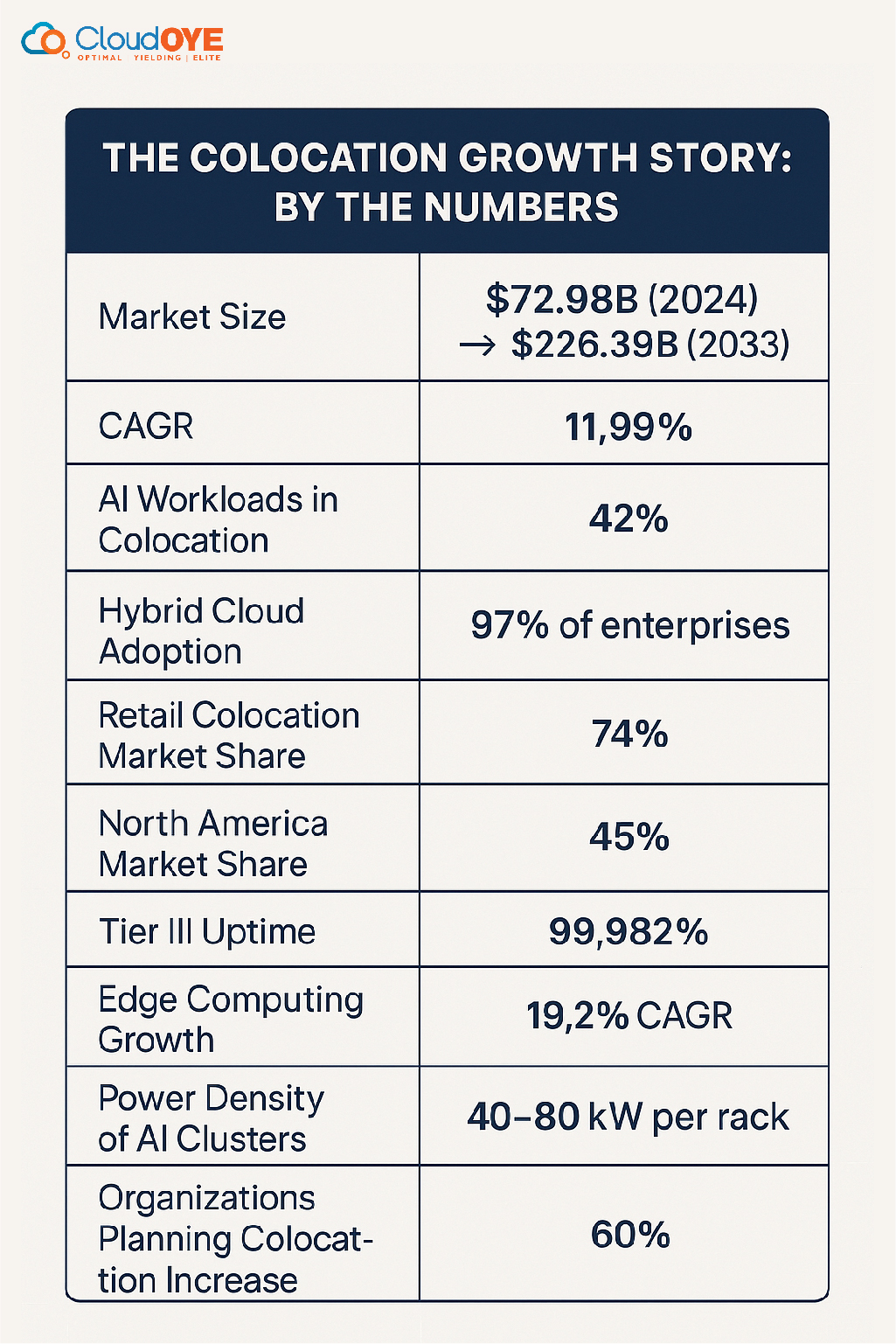
The global data center colocation market has reached a staggering milestone. Valued at $72.98 billion in 2024, the industry is projected to surge to $226.39 billion by 2033, representing a compound annual growth rate (CAGR) of 11.99%. This explosive growth isn't coincidental—it's driven by the relentless demand for secure, scalable, and compliant IT infrastructure.
For tech leaders navigating digital transformation, students exploring cloud architectures, enterprises managing critical workloads, and developers building next-generation applications, understanding colocation services has become mission-critical.
What is Colocation Data Center Hosting?
Colocation data center hosting is a service model where businesses rent physical space within a professionally managed facility to deploy their own IT hardware. Unlike traditional cloud hosting where the provider owns everything, colocation gives you complete control over your equipment while the facility provides:
- Redundant power infrastructure with backup generators and UPS systems
- Advanced cooling systems including ambient and mechanical solutions
- Multi-layered physical security with biometric access controls and 24/7 surveillance
- Carrier-neutral network connectivity with diverse bandwidth options
- Fire suppression and environmental monitoring systems
Think of it this way: You own the car (your servers), but you're parking it in a premium garage (the data center) with professional maintenance, security, and utilities.
The State of Colocation Services in 2026
The colocation landscape is experiencing unprecedented transformation. Let's examine the numbers that matter:
Market Dynamics Reshaping Infrastructure
Retail colocation continues its dominance, commanding 74% of the market share in 2024. This segment appeals to enterprises seeking cross-connect-rich ecosystems and turnkey services. Meanwhile, wholesale colocation is growing rapidly as hyperscale customers demand massive contiguous blocks—some requiring 10 MW or more for single AI training clusters.
North America retains leadership with 45% revenue share, but Asia-Pacific is emerging as the fastest-growing region, driven by India's digital initiatives and the establishment of 100,000 Digital Villages by the Ministry of Electronics and Information Technology.
AI Workloads Are Changing Everything
Here's where things get interesting:
42% of generative AI workloads are now deployed in colocation facilities rather than public cloud or on-premises cloud infrastructure. Why? Because AI training clusters routinely draw 40-80 kW per rack—a power envelope unsustainable in legacy air-cooled environments.
"Generative-AI training clusters may now require contiguous blocks of 10 MW, prompting multi-building campus plans that can scale to 300 MW on day-one land banks," according to industry analysis from Mordor Intelligence.
This shift is pushing server colocation providers to integrate liquid cooling technologies (direct-to-chip and immersion cooling) to support high-density workloads while lowering energy consumption.
Edge Computing Meets Colocation
75% of data computing is moving to the edge by 2026. Edge computing reduces latency by processing data close to its source—crucial for autonomous vehicles, smart manufacturing, and real-time analytics.
Colocation providers are responding with modular edge-pod deployments, growing at a remarkable 19.2% CAGR. These compact facilities bring enterprise-grade infrastructure to under-served metros and population hubs.
Core Benefits Driving Colocation Adoption
1. Cost Efficiency Without Compromise
Building a private data center requires $10-15 million in upfront capital for a modest facility. Colocation slashes this to predictable monthly operating expenses while delivering:
- Shared infrastructure that leverages economies of scale
- Elimination of construction timelines (deploy in weeks, not years)
- Reduced staffing requirements for facility management
- Optimized power usage effectiveness (PUE) ratios below 1.3
2. Enterprise-Grade Security & Compliance
Security breaches cost enterprises an average of $4.45 million per incident in 2024. Colocation facilities mitigate risk through:
Physical Security Measures:
- Perimeter barriers with anti-climbing features
- Biometric authentication systems and key card access
- Containment areas (mantraps) for identity verification
- 24/7 surveillance with motion sensors and alarms
- Security personnel with industry certifications
Compliance Frameworks: Colocation providers maintain certifications for GDPR, HIPAA, PCI-DSS, SOX, and ISO 27001, ensuring your infrastructure meets regulatory standards without the overhead of maintaining these programs internally.
For government and public sector organizations, MeitY-empanelled data center in India provide additional assurance. These facilities undergo rigorous audits by the Standardisation Testing and Quality Certification (STQC) Directorate, verifying compliance with government standards for quality, availability, and security.
3. Scalability at Speed
60% of enterprises plan to increase colocation usage within the next 12-24 months. The reason? Instant scalability.
Need to expand from 5 racks to 50? It takes weeks in a colocation facility versus months or years building your own space. This agility is critical when:
- Launching new products or services
- Expanding into new geographic markets
- Accommodating M&A-driven infrastructure consolidation
- Supporting seasonal traffic spikes
4. Hybrid Cloud Enablement
97% of organizations have implemented or plan to implement hybrid cloud models. Colocation serves as the crucial bridge between on-premises infrastructure and public cloud services.
Modern colocation facilities offer direct cloud interconnection to 15-20 major cloud platforms including AWS, Azure cloud, and Google Cloud. This "cloud on-ramp" architecture delivers:
- Reduced data egress fees (saving 20-30% on bandwidth costs)
- Single-digit millisecond latency to cloud resources
- Simplified multi-cloud deployments
- Enhanced data sovereignty compliance
"Cloud interconnection was the No. 1 reason for using colocation for nearly half of the 22 workloads" surveyed in industry research, yet only 31% of providers currently offer comprehensive interconnection services—a gap that leading facilities are rushing to fill.
Critical Selection Criteria for Colocation Providers
Location Strategy Matters
Geographic proximity affects three critical factors:
-
Latency: Every 1,000 miles adds approximately 10ms of latency
-
Disaster Recovery: Facilities should be outside primary risk zones for natural disasters
-
Data Sovereignty: Certain regulations require data to remain within specific jurisdictions
Pro tip: Consider a distributed colocation strategy with facilities in multiple metros to balance performance, resilience, and compliance.
Power & Cooling Infrastructure
Ask these questions before signing contracts:
-
What's the facility's PUE rating? (Target: below 1.4)
-
How many redundant power paths exist? (N+1 minimum, 2N preferred)
-
What cooling technologies are deployed? (Air, hybrid, liquid)
-
Can the facility support high-density racks exceeding 15 kW?
Network Connectivity & Bandwidth
Carrier-neutral facilities provide the most flexibility. Verify:
-
Number of on-net carriers and internet service providers
-
Availability of diverse fiber entry points
-
Options for private cross-connects to cloud hosting providers
-
Bandwidth scalability and upgrade paths
Service Level Agreements (SLAs)
"The devil is in the details." Examine SLA guarantees for:
-
Uptime: 99.99% (52 minutes downtime/year) should be standard
-
Power availability: Measured separately from network uptime
-
Response times: How quickly does support engage for incidents?
-
Financial penalties: What compensation exists for SLA breaches?
Cloudoye's Tier III Data Center Advantage
Cloudoye has established itself as a trusted infrastructure partner for enterprises across India, operating Tier III certified data centers in strategic locations including Noida and Bangalore.
Infrastructure Excellence
Noida Facility Highlights:
-
Over 500 rack spaces across two dedicated floors
-
99.95% network uptime guarantee backed by redundant systems
-
Multiple ISP presence including Bharti Airtel, Tata, TTSL, Reliance, and BSNL
-
24/7 on-site technical support with rapid response protocols
Bangalore Data Center:
-
1,000+ rack capacity with 5MW IT power supply
-
99.99% uptime guarantee supported by redundant power and cooling
-
Multiple IX, content & IP peering nodes for optimized connectivity
-
State-of-the-art security with biometric access controls
Comprehensive Service Portfolio
Beyond basic rack space, Cloudoye delivers:
-
Managed colocation services with proactive monitoring
-
Disaster recovery solutions with geographically diverse backup locations
-
Cloud integration services enabling hybrid architectures
-
Scalable bandwidth options from Mbps to multi-Gbps connectivity
With over 20 years of experience in cloud and infrastructure services, Cloudoye combines technical expertise with customer-centric support, ensuring your critical applications receive enterprise-grade hosting at competitive prices.
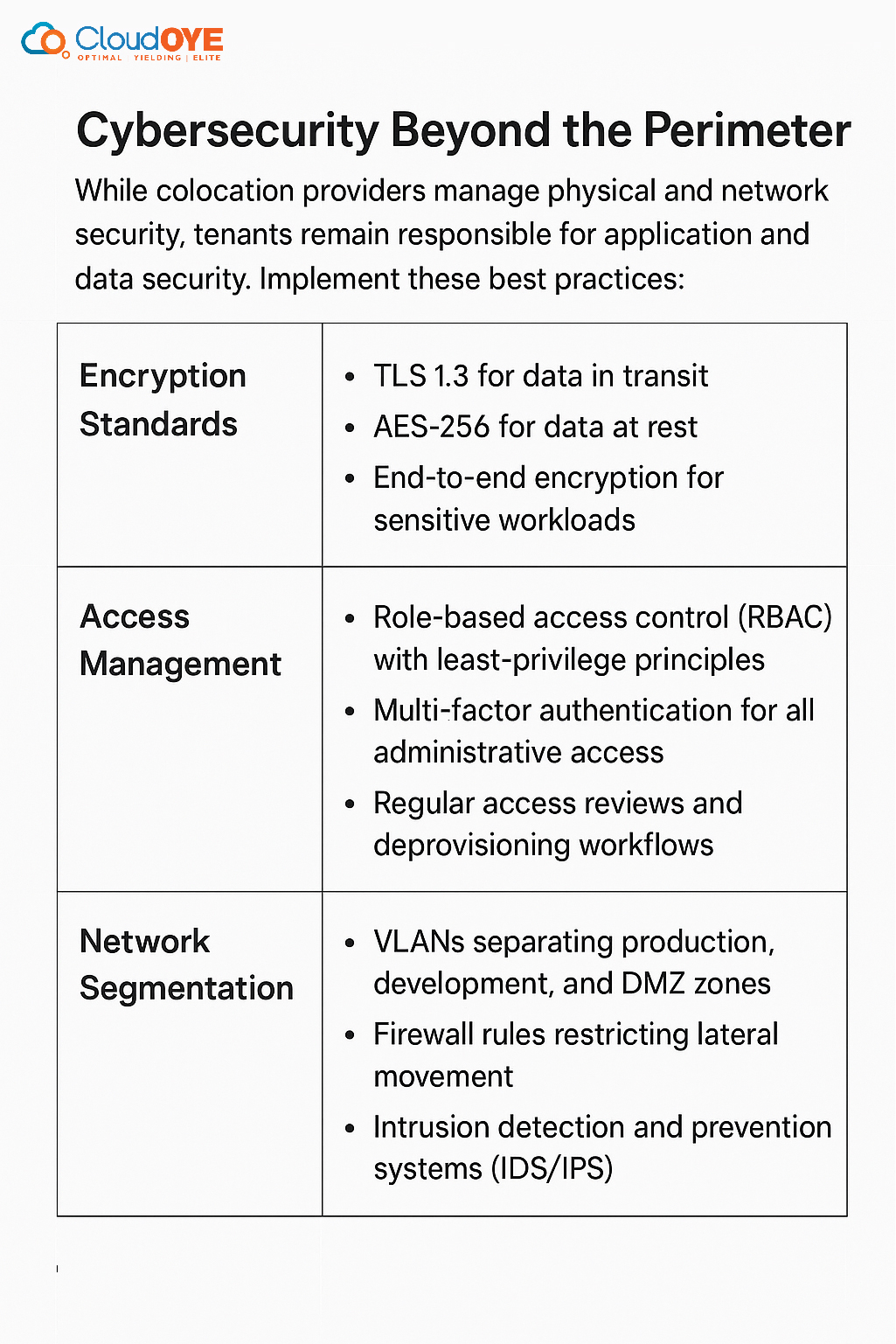
Security Measures That Actually Matter
Compliance Automation
"Compliance is not a checkbox—it's a continuous process."
Leading colocation customers implement:
- Automated security patching with predefined maintenance windows
- Configuration management tools ensuring consistency
- Audit trail logging with immutable storage
- Vulnerability scanning on weekly or monthly schedules
Future Trends Shaping Colocation Services
Sustainability Becomes Non-Negotiable
By 2026, an estimated 35% of colocation facilities will be powered by renewable energy sources. Regulatory pressures and corporate ESG commitments are accelerating this transition.
Leading providers are implementing:
- On-site solar and wind generation
- Power purchase agreements (PPAs) for renewable energy
- Waste heat reuse programs (district heating partnerships)
- Water-free cooling technologies
Liquid Cooling Goes Mainstream
Traditional air cooling can't support AI workloads demanding 40+ kW per rack. Liquid cooling systems are projected to grow at 18%+ CAGR through 2030, offering:
- 40% reduction in energy consumption versus air cooling
- Support for densities exceeding 100 kW per rack
- Quieter operations (no massive air handlers)
- Reduced facility footprint requirements
Edge Colocation Explodes
Over $6 billion was invested in edge computing in 2024, with 74% directed toward edge data center facilities. This trend creates opportunities for:
- Micro data centers serving specific metros or campuses
- Mobile edge computing nodes at cellular towers
- Industrial edge facilities within manufacturing plants
Common Pitfalls to Avoid
Underestimating Power Requirements
Many organizations deploy with 30-40% less power capacity than they'll need within 24 months. Always:
- Plan for 50% growth buffer in power and cooling
- Understand power measurement (kW vs. kVA)
- Account for UPS overhead and efficiency losses
Ignoring Remote Hands Costs
"Remote hands" services—where facility staff perform basic tasks on your behalf—seem convenient until the invoices arrive. A simple server reboot can cost $150-300 per incident.
Better approach: Deploy intelligent PDUs and out-of-band management (IPMI, iLO, iDRAC) to minimize truck rolls.
Overlooking Contract Flexibility
Standard contracts run 36-60 months with minimal flexibility. Negotiate:
- Expansion rights at contracted rates for additional space
- Downsizing provisions if business conditions change
- Early termination clauses with reasonable penalties
- Price protection against escalating power costs
Integration with Disaster Recovery Strategy
Colocation facilities serve as ideal disaster recovery sites when:
1. Geographic separation exists: Minimum 50 miles from primary location
2. Infrastructure independence: Different power grids and network providers
3. Adequate capacity: Full replication capability, not skeleton infrastructure
4. Tested regularly: Quarterly DR tests, not theoretical plans
Recovery Time Objective (RTO) targets should drive design:
- RTO < 1 hour: Active-active configuration with real-time replication
- RTO 1-4 hours: Active-passive with automated failover
- RTO 4-24 hours: Manual failover with documented runbooks
Accelerate Your Digital Infrastructure with Cloudoye
The colocation market's trajectory toward $226 billion by 2033 reflects a fundamental shift: enterprises recognize that world-class infrastructure doesn't require world-class capital expenditure.
Whether you're a fintech startup scaling transaction processing, a healthcare provider ensuring HIPAA compliance, a manufacturing firm deploying IoT analytics, or a SaaS company expanding globally—colocation delivers the reliability, security, and scalability modern businesses demand.
Stop managing infrastructure. Start leveraging it.
Cloudoye's Tier III certified data centers in Noida and Bangalore provide the foundation for your next growth phase. With 99.99% uptime guarantees, MeitY-compliant facilities, and 20+ years of operational excellence, we've engineered infrastructure that lets you focus on what matters: building exceptional products and experiences.
Ready to explore how colocation transforms your IT strategy?
Contact Cloudoye's infrastructure specialists today for a customized assessment of your requirements and a no-obligation tour of our facilities.
Frequently Asked Questions
1. What's the difference between colocation and cloud hosting?
Colocation means you own and control your hardware deployed in a third-party facility. Cloud hosting means you rent virtual resources from a provider who owns the infrastructure. Colocation offers more control and potentially lower long-term costs, while cloud provides faster provisioning and pay-as-you-go flexibility.
2. How much does colocation typically cost?
Costs vary dramatically based on location, power density, and services. Expect $150-500 per kW per month for basic colocation in Tier-2 cities, rising to $200-800 in major metros. Quarter-rack spaces start around $300-600/month, while full cabinets range from $1,200-4,000/month depending on specifications.
3. What is a Tier III data center and why does it matter?
Tier III certification (from Uptime Institute) guarantees 99.982% availability (1.6 hours downtime annually) through redundant power and cooling paths. It provides N+1 redundancy, allowing maintenance without downtime—critical for production workloads. Tier III facilities balance reliability with reasonable costs, making them ideal for most enterprises.
4. Can I visit my equipment anytime in a colocation facility?
Most facilities provide 24/7/365 physical access for customers, though you'll need to follow security protocols (escort requirements, sign-in procedures, approved access lists). Some lower-cost providers restrict access to business hours or require advance notice. Always clarify access policies before contracting.
5. How is colocation security different from on-premises?
Colocation facilities typically exceed on-premises security through: multi-layered perimeter defenses, biometric access controls (fingerprint/retina scanners), 24/7 security staff with military or law enforcement backgrounds, bollards and vehicle barriers, sophisticated fire suppression systems, and environmental monitoring. Few enterprises can cost-effectively replicate these measures.
6. What's the minimum commitment for colocation services?
Standard contracts range 24-60 months. Some providers offer month-to-month arrangements at premium pricing (typically 30-50% above annual contract rates). Longer commitments (48-60 months) can yield 10-20% discounts but reduce flexibility. Negotiate carefully based on your growth trajectory.
7. How do I estimate my power and space requirements?
Calculate total watts consumed by all equipment (servers, network gear, storage), add 20-30% for redundancy and growth, then convert to kW. For space, count rack units (U) needed—most servers are 1-2U, network switches 1U, storage arrays 2-4U. A standard 42U rack typically accommodates 35-38U of equipment after accounting for cable management and airflow gaps.
8. What happens if the colocation provider goes out of business?
This risk, while rare, deserves attention. Your equipment remains your property—providers can't seize it. However, you may face forced migration. Mitigate risk by: verifying provider financial stability, maintaining equipment inventory and configurations, ensuring your team has facility access credentials, and negotiating extended notice periods in contracts (90-180 days preferred).
9. Can colocation support hybrid cloud architectures?
Absolutely—in fact, colocation excels as the foundation for hybrid cloud. Modern facilities offer direct connections to AWS Direct Connect, Azure ExpressRoute, Google Cloud Interconnect, and other cloud on-ramps. This architecture combines colocation's control with cloud's elasticity, enabling workload placement based on performance, security, and cost requirements


